
Two years ago, most companies did not have a marketplace profitability lead, a retail media owner, a lifecycle monetization director, or a revenue systems head.
Today, the companies outperforming their peers have something in common. They assigned ownership to emerging growth constraints before the titles became standard.
This is not about trend chasing.
It is about organizational design.
Growth is moving faster than most org charts can keep up
Leadership teams set bold plans. They launch new channels, add subscriptions, grow marketplace presence, invest in retail media, tighten margins, and test new revenue streams.
Drive is not the problem.
Structure is.
When new initiatives start, they get split across teams. Marketing owns part. Ecommerce takes another piece. Finance reports on it. Operations run execution.
Everyone plays a role.
No one owns the full financial result.
Over time, that split focus slows progress. Revenue never reaches its full potential. Costs rise. Reporting gets messy. Accountability becomes unclear.
When growth stalls in this setup, it is rarely about capability. It is about how the business is organized.
The hidden cost of undefined ownership
Many companies hesitate to create new roles because they feel premature. There may be no clear market benchmark or obvious reporting line. It feels safer to distribute the responsibility across existing teams.
That safety creates drag.
When no one owns pricing across channels, margin erosion goes unchecked. When no one owns lifetime value, acquisition spend outpaces retention strategy. When no one owns marketplace profitability, top line growth masks declining contribution.
Marketing celebrates the ROAS, Operations complains about fulfillment costs, and Finance wonders why the overall margins are shrinking.
The absence of ownership does not stop the work from happening. It prevents it from compounding.
By the time the role feels obvious, competitors who defined it early have already built operational leverage.
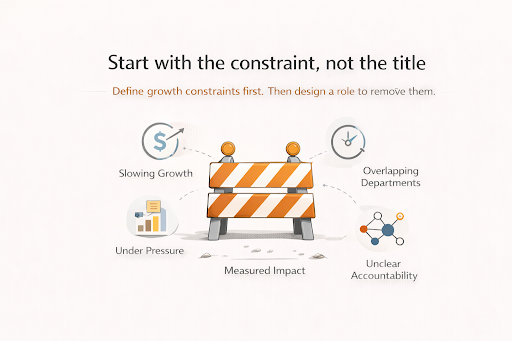
Start with the constraint, not the title
The mistake begins with a job title.
The better starting point is a financial bottleneck.
Where is growth slowing despite investment? Where is profitability under pressure? Where are decisions crossing departments without a single owner? Where is accountability unclear?
Define the constraint in measurable terms. Quantify its impact on revenue, margin, cost, or speed.
Then design a role with a clear mandate to remove it.
Not coordinate it. Remove it.
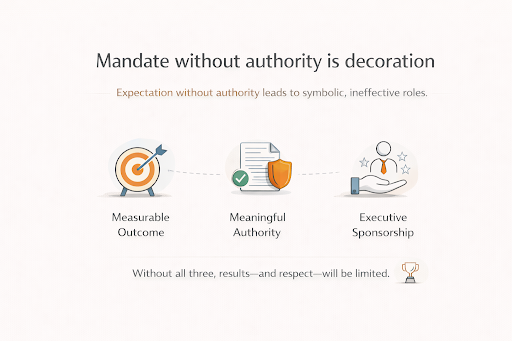
Mandate without authority is decoration
Creating a new title is easy. Designing it correctly is harder.
Before hiring, leadership should be explicit about three elements. We call this The Triangle of Effective Ownership:
- The twelve-month business outcome. This should be measurable and financial, not a list of tasks.
- The authority required. If the role is expected to influence revenue, it must sit near revenue leadership. If it is expected to protect margin, it needs access to pricing, cost data, and cross-channel decision rights.
- Executive sponsorship. Without visible backing, cross-functional roles struggle to drive alignment.
When expectation exceeds authority, progress slows, and the role becomes symbolic.
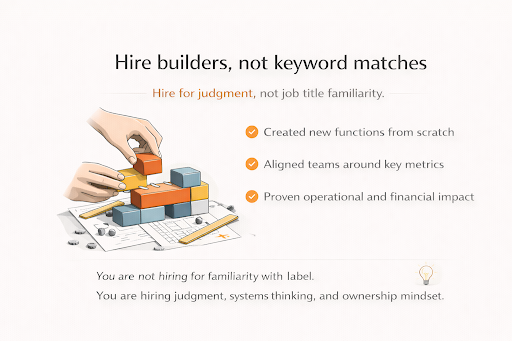
Hire builders, not keyword matches
Because these roles are new, there is rarely a perfect resume.
Insisting on direct experience in an identical title often results in hiring after the opportunity has passed.
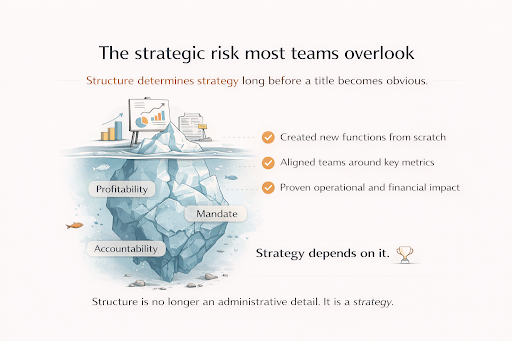
Instead, prioritize candidates who have built functions from scratch, aligned teams around a shared metric, and translated operational change into financial impact.
You are not hiring for familiarity with a label.
You are hiring judgment, systems thinking, and an ownership mindset.
The Anti-Resume Interview
Traditional interviews emphasize credentials and past responsibilities. Emerging roles demand something different.
Present a real scenario: marketplace revenue is increasing, but contribution margin is declining. Marketing cites fees. Operations cites pricing. Finance cites discounting.
Ask the candidate how they would approach the first ninety days.
Strong operators will:
- Begin with unit economics
- Clarify accountability boundaries
- Align incentives
- Establish a reliable source of truth
- Define measurable targets
Execution quality begins with structured thinking.
The strategic risk most teams overlook
The greater risk is not hiring the wrong person.
It is assuming yesterday's structure can absorb today's complexity.
New revenue streams without ownership become side projects. Cross-channel initiatives without accountability create friction. Strategic priorities without mandate remain presentations rather than performance drivers.
Over time, the roles that seem early today will become standard.
The advantage belongs to the organizations that define them while the constraint is still manageable.
Structure is no longer an administrative detail.
It is a strategy.
A practical test for your leadership team
This quarter, list your top three growth priorities.
For each one, answer two questions:
- Who owns the financial outcome end-to-end?
- Do they have the authority to change cross-functional behavior?
If either answer is unclear, you have identified a structural gap.
That gap is likely costing more than you realize.
This is where many executive teams stall. The constraint is visible, but translating it into the right mandate, reporting line, and hire profile requires precision.
We work with leadership teams to:
- Identify the true financial bottleneck behind stalled growth
- Define the mandate, metrics, and authority required to remove it
- Design the reporting structure to support cross-functional execution
- Build a hiring brief grounded in measurable impact
- Assess candidates for ownership mindset and systems thinking
The goal is not to add headcount. It is to eliminate structural friction that limits scale.
If you're unsure where the friction lives in your org, or whether your current design can carry the weight of your next growth phase, let's talk.